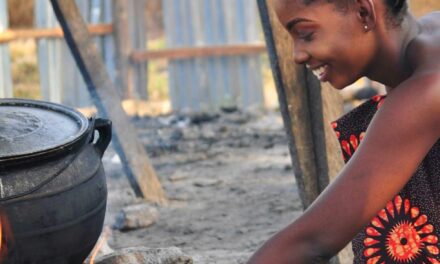

I remember growing up in northern KwaZulu-Natal, in a coastal village where the air always carried a mix of salt and smoke. Cooking was not something that happened in isolation. It was part of the rhythm of the day. Wood would crackle before sunrise, pots would be set without announcement, and food would come together in a way that felt both ordinary and precise.
No one spoke about nutrition. No one counted anything. Yet people ate in a way that sustained them through long days, whether in the fields, at school, or walking distances that today would feel unreasonable.
Looking back, it is difficult to ignore how complete those meals were. Not in presentation, but in purpose.
The pot that fed everyone
Samp and beans was not a “recipe” in the formal sense. It was a given. You knew it would be there, especially on days when the household needed something that would stretch.
The pot would sit for hours, slowly softening, thickening, becoming something that could carry a family through the day and into the next. There was no urgency to it. Just patience.
What stands out now is not only that it fed many people, but that it did so well. It was filling without being heavy, simple without being lacking. Today, it would be described as a balanced meal. At the time, it was just food.
According to the Food and Agriculture Organization, combining grains and legumes creates a complete protein, making meals like these both nutritionally adequate and accessible (FAO). What was once instinct is now explained through science.
Straights from the ground
Leafy greens were never bought in neat plastic packaging. They were picked, sometimes from just beyond the yard, sometimes from fields nearby. Morogo was part of everyday eating, not something reserved for special occasions or health-conscious moments.
It was cooked simply. Steamed down, softened, and then brought to life with groundnut sauce or onions and tomatoes. There was an understanding, unspoken but consistent, that food did not need to be overworked to be good.
Those meals carried nutrients that are now widely discussed. Leafy greens rich in iron and vitamins. Groundnuts providing healthy fats and protein. At the time, none of that language existed in the kitchen. What existed was knowledge passed through doing.
The gut health breakfasts
Mornings often began with soft porridge or something fermented. Slightly sour, familiar, steady. Sometimes it was shorgum, others yellow maize with lemon squeezed and a little bit of sugar cane for extra flavour. It was the kind of food that stayed with you.
Fermented foods are now recognised for supporting gut health and improving nutrient absorption, something widely documented in food science research (NCBI). In the village, it was simply how things were done. Grain was soaked, left, and transformed naturally. No one needed to explain the process for it to make sense.
It worked. That was enough.
What we already knew
What feels striking now is how far removed these meals are from how healthy eating is often presented today. There is an assumption that eating well requires access to something new. Something imported. Something elevated.
Yet the meals from that kitchen in northern KwaZulu-Natal were already doing the work. They were affordable, accessible, and deeply aligned with the environment. They wasted little, relied on what was available, and fed people properly.
The shift that is needed is not necessarily in what people eat, but in how they see what they already have. These meals are not lesser versions of modern diets. They are complete systems in their own right.
What many are now trying to build or buy into already existed, quietly, in places that were never trying to prove anything.